Dr Omar Mamad has received a new award with grant funding from FutureNeuro, the Research Ireland Centre for Translational Brain Science, to support the lab's work on CDKL5 Deficiency Disorder. The €128,800 award funds "The Broken GPS" — a project using single-place-cell recording to build the first cross-model atlas of how the brain's internal GPS breaks down across CDD, TLE, TBI, 22q11.2 deletion syndrome, and Dravet syndrome.
- New Funding Awarded: The Broken GPS — Single-Place-Cell Recording Across Neurological Diseases
Dr Omar Mamad has received a new award with grant funding from FutureNeuro, the Research Ireland Centre for Translational Brain Science, to support the lab's work on CDKL5 Deficiency Disorder.
The proposal, "The Broken GPS: Single-Place-Cell Recording Across Neurological Diseases," has been awarded €128,800 through the FutureNeuro Strategic Funding Call, funded by the Research Ireland FutureNeuro Phase 2 award.
The problem we're tackling
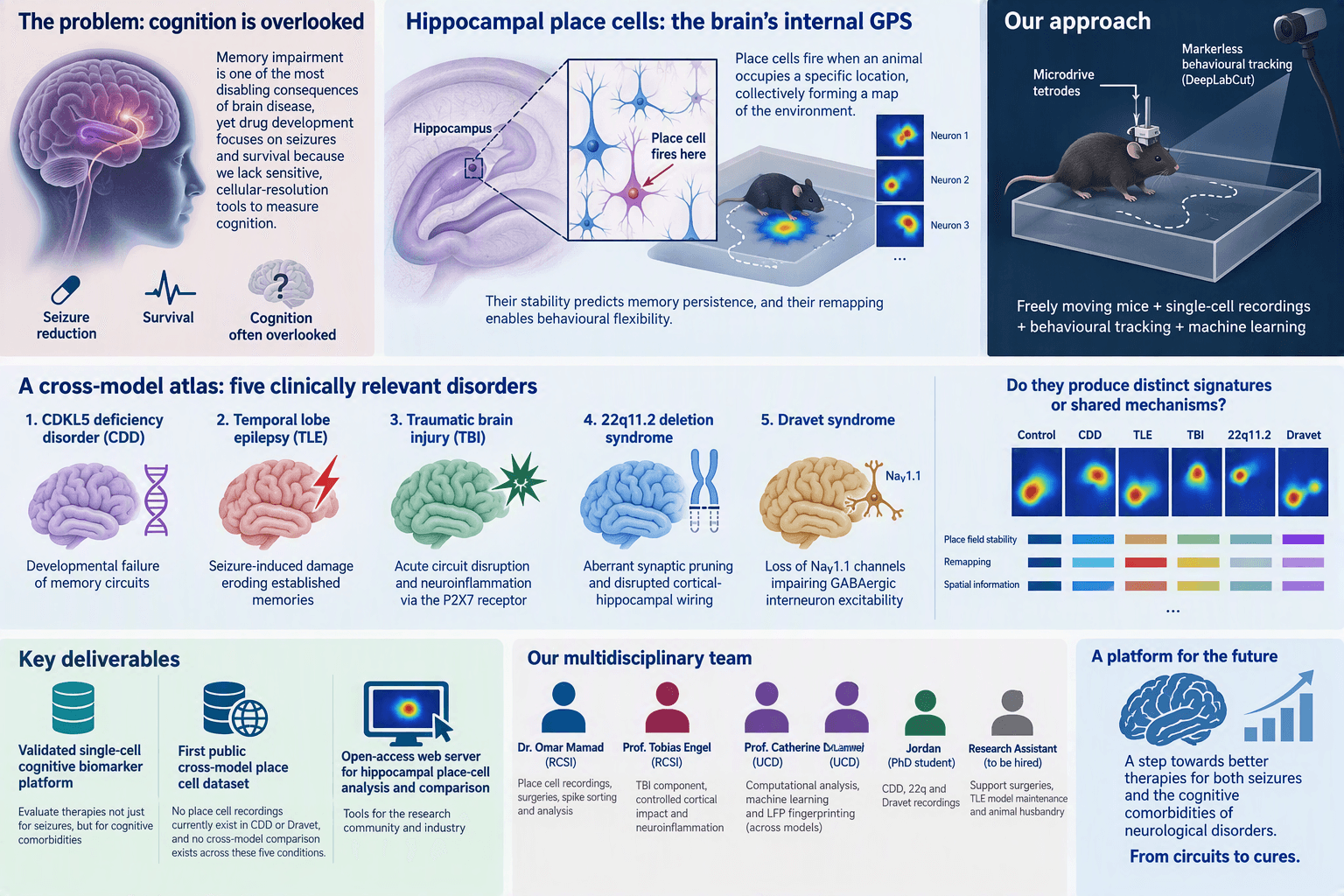
Memory impairment is one of the most disabling consequences of brain disease for patients and caregivers — and it consistently ranks above seizure control or motor symptoms as a determinant of quality of life. Yet preclinical drug development remains heavily focused on seizure reduction and survival, not because cognition matters less, but because we lack sensitive, cellular-resolution tools to measure it.
At the cellular level, memories are encoded in the firing patterns of individual neurons. Among these, hippocampal place cells are a striking example: they fire when an animal occupies a specific location, collectively forming the brain's internal GPS. Their stability predicts memory persistence, and their remapping enables behavioural flexibility — making place cell dysfunction the closest thing we have to a direct cellular readout of cognitive failure.
What the project will do
This project will generate the first cross-model atlas of hippocampal place cell function at single-cell resolution across five clinically relevant models representing key research and commercialisation focuses for FutureNeuro:
CDKL5 deficiency disorder (CDD)
Temporal lobe epilepsy (TLE)
Traumatic brain injury (TBI)
22q11.2 deletion syndrome
Dravet syndrome
Using microdrive tetrode recordings in freely moving mice, combined with markerless behavioural tracking (DeepLabCut) and machine-learning pipelines for latent neural representations, we will ask whether each disorder produces a distinct hippocampal signature — from destabilised place fields and degraded remapping to reduced spatial information content — or whether they converge on shared mechanisms of dysfunction.
A platform for the future
The central deliverable is a validated single-cell cognitive biomarker platform that can be used to evaluate therapies not just for seizures, but for the cognitive comorbidities of neurological disorders — addressing a genuine unmet need in drug discovery. Alongside this, we will release the first public cross-model place cell dataset and an open-access web server for hippocampal place-cell analysis and cross-model comparison.
The team
This project is only possible through multidisciplinary collaboration across the Centre:
- Dr. Omar Mamad (Lead Applicant, FutureNeuro Investigator, RCSI) — place cell recordings, microdrive preparation, surgeries, spike sorting and analysis
- Prof. Tobias Engel (Co-Applicant, FutureNeuro Investigator, RCSI) — TBI component, controlled cortical impact surgeries and neuroinflammation correlation
- Prof. Catherine Mooney and Dr. Lan Wei (Co-Applicants, FutureNeuro Investigators, UCD) — computational analysis, machine learning and LFP fingerprinting across models
- Jordan (PhD student) — CDD, 22q and Dravet recordings
- A Research Assistant will be hired to support surgeries, TLE model maintenance and animal husbandry